
At the northern end of the Mar Chiquita lagoon, the communities of Los Porongos, El Huaico, and Limache coexist across more than a million hectares of water, salt, and wildlife. Among mud houses, migratory birds, and ancestral knowledge, a story of resilience, hospitality, and community conservation unfolds.
In 2025, Natura Argentina implemented a social strengthening project based on the Dialogue of Knowledge. This approach recognizes that both scientific knowledge and local ancestral wisdom are fundamental for effective conservation. Through this community process, the residents of Los Porongos shared and valued the Living Knowledge that defines their relationship with the land, essential for survival and the sustainable management of resources. Thus, we discovered that some knowledge is passed down from generation to generation, such as working with wool or the art of building mud homes, all in deep communion with the environment.
Living knowledge is knowledge that is created and recreated in the present. It arises from the encounter between everyday experience and collective memory, and it transforms with each practice, each landscape, and each conversation. At Natura Argentina, we understand it as a bridge: a dialogue between local knowledge and science, where each perspective enriches the other and helps us better care for the territories we share.
The Value of Water
In this vast territory, the collection of rainwater in each home, taking into account the periods of abundance and scarcity of this vital resource, demonstrates an understanding of nature's rhythms, as well as its sustainable use and a reduced dependence on river water.
The Silent Mammals
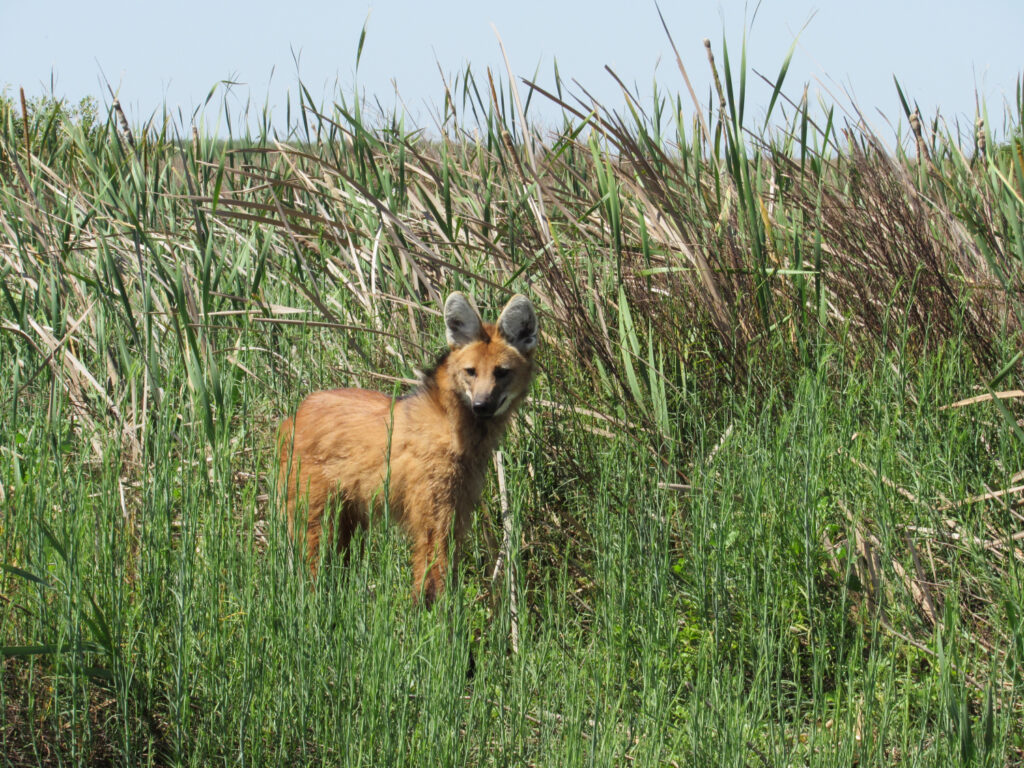
Local fauna was recorded using camera traps, always placed with the families' permission. Among the surprises was the pampas fox, a species not often seen.
Birds of the Wetland
The guidance and support of the community, along with the technical expertise of the team and the censuses led by nature photographer and tourism technician Ramiro Ramirez, were key to obtaining the surprising result that 47% of the bird species recorded in Santiago del Estero can be observed in this area.
The School as the Center of Everything
In Los Porongos, the rural school is much more than a classroom. It is the community's meeting point and, often, the place where everything happens. Children of different ages share the classroom and daily life, and projects are built collaboratively.
A collective mural inspired by the local wildlife and the nearby lagoon was created there. It remains etched on one of the walls, serving as a reminder that the school is also part of the landscape.
Living, Working, and Being Part of the Territory
Working in this region is very challenging: the extreme heat, the salty wind, the lack of water at certain times of the year. But upon arriving at each home, the families welcome the team with a kindness that dispels any difficulties. Mate, conversation, grilled cakes, shared time: all of this builds a bond that facilitates the work and allows for a better understanding of life in a wetland like this.
The work in Los Porongos is fundamental, since the Bañados del Río Dulce (Dulce River Wetlands) have critical conservation value by retaining and storing freshwater, essential for wildlife, human consumption, and production. Furthermore, the wetlands play an important and large-scale role in addressing global warming, climate change, and habitat degradation.
A process that keeps going on
t degradation. A process that continues to evolve. The work in Los Porongos doesn't end with a workshop or a trip. Each visit opens up new questions and new ways to collaborate. In the same way that the wetlands hold water to sustain life, the community holds stories and knowledge that help us think about how to care for the territory in the future.
This process is precisely that: a shared path, built little by little, with listening and respect. And as long as the dialogue remains open, conservation also has a future.